

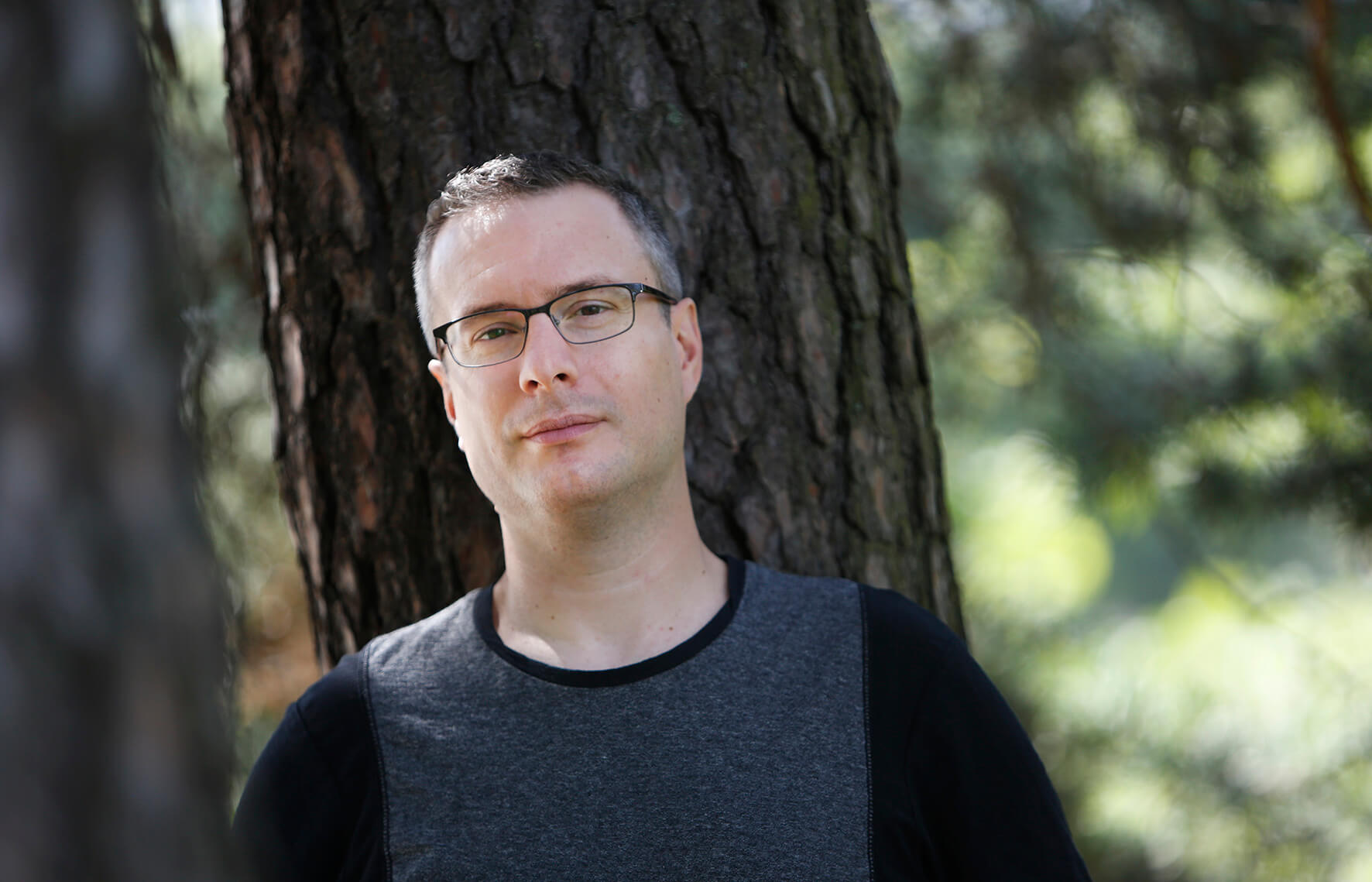
The light behind the landscape
The music of Matthew Whittall opens up landscapes: vast silences, currents of melodies, arches of meditative sound that make time stand still. Since the mid-2000s, his soundscapes have dwelled on nature experiences, both personal and universal – one example being the 25-minute-long The Return of Light (2015) for chamber orchestra and choir, diving into polar darkness, sounds of the ice and the first ecstatic rays of the sun. During the past few years, though, his music has been drifting towards another direction, that of abstraction.
“For 20 years I have been struggling against the preconception that composing about nature was naïve romanticism. And now when nature themes are everywhere, I feel like going somewhere else,” he says with a laugh.
Joy for organ and orchestra
An important point on this path was reached last May with the premiere of his symphony for organ and orchestra, Joy, written for the Finnish Radio Symphony orchestra and the brand new organ of the Helsinki Music Centre. The work was an homage to Kaija Saariaho, whose coloristic music had been a major influence for Whittall early on his career.
Hailing from a small town in Quebec, Canada, Whittall has called Finland his home since 2001. As with Saariaho, the roots of his musical idiom lie within the French tradition. “That is why writing symphonies has never appealed to me,” he explains. “Usually, images are the driving force behind my compositions, but Joy kept shrugging off all images and moved further towards abstraction.”
At some point, Whittall realised that he was writing a symphony after all. A process of this kind was already emerging in the large-scale, four-movement piano concerto Nameless Seas (2017). The world premiere took place on 5 October 2017 in Ottawa, Canada by the National Arts Centre Orchestra with Angela Hewitt as the soloist.
Orchestral flows
Though at home with solo piano and chamber ensembles and, especially, choral music – having many of his compositions performed by the energetic Finnish amateur and professional choirs – Whittall is in his element with the symphony orchestra, both on its own and with vocal forces or instrumental soloists.
Recent orchestral works include, in addition to the organ symphony Joy, Silence Speaks with intimate modal harmonies (2022, commissioned by the Helsinki Philharmonic Orchestra as part of the Helsinki Variations series), and the cantata-like These Things Remain (2019), commemorating Canadian soldiers who fought in World War II.
At times euphorically tonal, sometimes driven by pure noise, Whittall’s music has an inspirational flow that doesn’t shun influences outside the conventional contemporary-classical framework. With vocal music, the choice of poetry is important for him. With the choral cycle Songs of Travel, his compositions for choir have been moving towards larger forms, culminating in November 2025 with The World Tree, a concert-long work celebrating the 15th anniversary of the Helsinki Chamber Choir.
Composed to original poetry by the British author Robert Macfarlane, the work is in part a symbolic requiem for the famous Sycamore Gap Tree, a centuries-old sycamore in Northumberland, England, that was felled in an act of vandalism last autumn.
Lately, due to the constant presence of looming environmental crises in public discourse, nature as a subject has been politicized. Whittall is wary of making strong statements through art. “I feel more drawn to making my point indirectly, symbolically, instead of shouting out loud,” he says. “Art has the power of inviting the audience in, to reflect. Music can give people an emotional stake in nature. You cannot defend our environment if you don’t feel connected to it.”
Going off-road
Whittall is fascinated with music’s possibility of taking time and immersing the audience with spaciousness and stillness. “With long-ranged works of music you have the time to make a point really slowly, to build a whole world around an idea.” Nature as life force is still ever-present in Whittall’s music, though more in a metaphorical way.
His Oboe Concerto will be premiered in December 2024, a joint commission by the Tapiola Sinfonietta and the Vaasa Symphony Orchestra for soloist Anni Haapaniemi. It reflects on the transition from winter to spring and the overwhelming contrast between darkness and light, already elaborated in The Return of Light.
From experiencing the aurora borealis as a schoolboy to numerous hikes in Lapland over the years, the wonder inspired by natural phenomena has nourished Whittall’s creative imagination.
“The landscapes are still there, but more metaphorically, as if I were trying to see past the object into the light behind it. This is something I have always tried to do, to extend the music so that the listener feels captivated, and changed by it. A feeling of being filled by a silent landscape. That is the abstraction I’m interested in.”
Matthew Whittall will turn 50 next January. Before, he used to sketch his compositions carefully. Lately, he has been drawn more and more to the “question mark parts” of his drafts, giving way to the unexpected and letting the music take its own form. A musical off-road hike, in a way.
“In the organ symphony Joy, I began composing not knowing where the process would lead, and that is something I’d like to do more in the future: exploring rather than planning.”
Read more about Matthew Whittall and his works
Auli Särkiö-Pitkänen
Photo: Maarit Kytöharju