

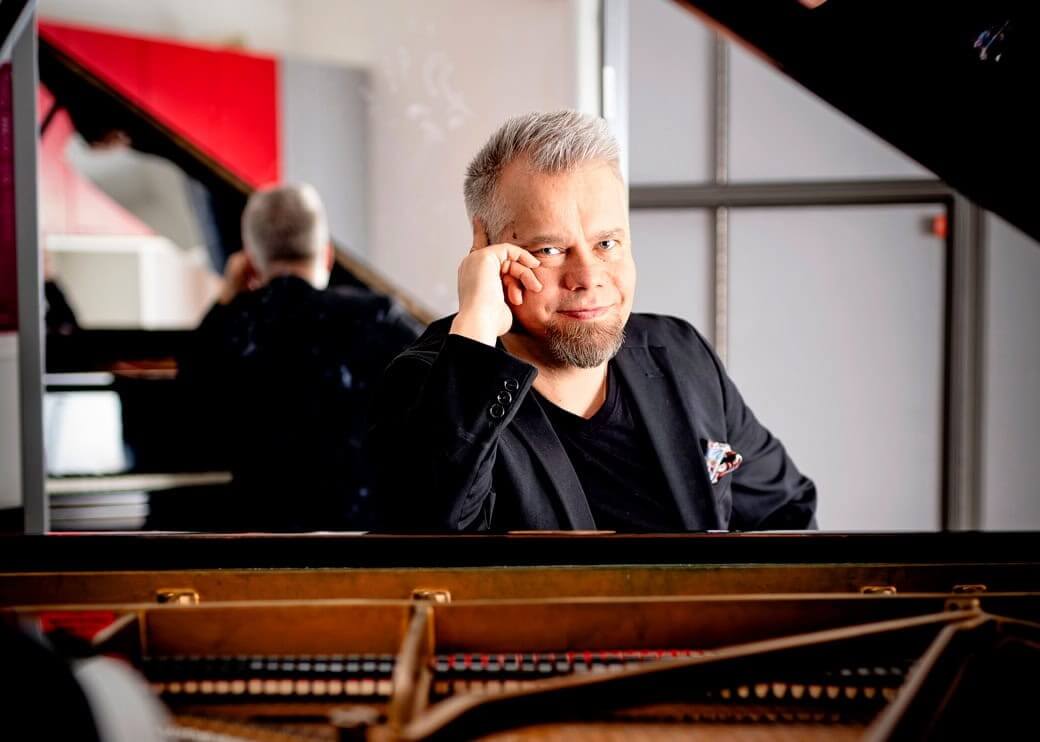
Focus on Pasi Lyytikäinen
Pasi Lyytikäinen (b. 1975) is an active and inclusive player in the field of contemporary art music, whose works span a wide range of ideas, ensembles and genres.
Pasi Lyytikäinen began his musical career as a child, playing the accordion on a train. He took up the flute at the Military Music School in Lahti, where he envisioned a career as a military band conductor. He developed an interest in music theory and composition through score study and began to experiment with compositions of his own.
At the age of 20, Lyytikäinen was accepted to study composition at the Sibelius Academy, where his teachers included Paavo Heininen and Erkki Jokinen. He also attended masterclasses given by Esa-Pekka Salonen, Magnus Lindberg, Michael Jarrell, Marco Stroppa and others. In 2002, he entered a piano duet composition competition with Par, which won a prize. This, along with his final project at the Sibelius Academy — a comic opera titled Helsinkiin (To Helsinki) based on the eponymous novel by Juhani Aho — launched his career as a professional composer.
Exploring further afield
Ever since his studies, Lyytikäinen has been an active and inclusive player in the field of contemporary art music, specifically in bringing performances out of concert halls and major cities. He has strong ties with his native region, North Savo in eastern Finland: he was the composer-in-residence of the municipality of Lapinlahti in 2000–2001 and established a contemporary music festival named Pasimusic in North Savo, being its artistic director from 2014 to 2018. He has also been a teacher at the Kuopio outpost of the Sibelius Academy, and the Kuopio Symphony Orchestra commissioned and premiered his First Symphony (2008). His recent Piano Concerto, written for Risto-Matti Marin, is to be premiered in Kuopio in autumn 2025.
Lyytikäinen explains that he developed an identifiable personal style in his early works but later felt the need to explore further afield. This stylistic expansion formed part of the motivation for him to undertake an artistically oriented doctorate at the Sibelius Academy, now part of the University of the Arts Helsinki. His doctorate, completed in 2025, discusses the regulating of the tension between noise and pitch, particularly in music for the stage.
The extensive portfolio of compositions included in his doctorate includes the trilogy of experimental opera performances titled Oopperaa arjessa (Opera in everyday life), a concertante work for accordion and mixed choir titled Mitä meille (What for us), La spada del sole for string quartet, a song cycle titled Lauluja — Sånger for soprano and piano and the cabaret-style monologue opera Der Unveröffentlichte Film der Eva Braun (The unpublished tape of Eva Braun) for soprano and chamber orchestra to a libretto by Maritza Núñez premiered in 2021.
All branches of the arts
Lyytikäinen’s catalogue spans a wide range of ensembles and genres: he has written orchestral, chamber, solo, vocal and stage works. Vocal music and music for the stage form an important part of his work. His interest in vocal music — along with a love of karaoke — originally emerged due to the influence of his teacher Paavo Heininen.
In vocal music, Lyytikäinen is particularly interested in text, which he considers a component of musical narrative that reaches beyond the music itself yet forms an essential part of the whole. His stage works go even beyond music and text into other branches of the arts. He also writes poetry and columns himself and at one point was a music journalist. He also considers drawing an important mode of expression, seeing both writing and drawing as complementing his toolkit as a composer.
Pasi Lyytikäinen notes that his musical roots are in the tradition of modernism where texture is an important element, but the musical appearance of his works varies from almost tonal to dissonant sounds and noise. His way of composing is highly pragmatic, and he often writes for a specific musician, singer or ensemble. Stylistic pluralism emerged as a feature in his work in the 2010s, sometimes blending various styles within a single work, as in the Eva Braun opera or the Piano Concerto. Other works may be stylistically coherent in themselves but differ substantially from each other even if written concurrently.
Sense of community
Lyytikäinen considers playing and games to be an essential tool for composition. He often proceeds from tiny musical ideas and germs through playing around with them to shape them into material usable for the project at hand. He identifies with the notion put forth by author Günter Grass of a musical idea being an onion that can be peeled layer by layer to get closer to its core.
Lyytikäinen is a social personality who balances the lonely work of a composer with teaching and likes to collaborate particularly with musicians performing his works. He finds a welcome sense of community in actively participating in civic organisations and in singing in a choir. He has collaborated with professional orchestras in Finland and with the New European Ensemble, the Zagros Ensemble and the Uuden Ajan Ensemble, and apart from Risto-Matti Marin with artists such as Joseph Tong, Mika Väyrynen, Veli Kujala, Eero Saunamäki, Sergei Tchirkov and Mirka Viitala. His music has been performed at several international festivals. A concert of his music is to be presented by a long-standing partner ensemble of his, the Seinäjoki City Orchestra.
Works of particular importance for Lyytikäinen himself include the choral work Tässä on lohtu (Here is Comfort) to a text by Henriikka Tavi (2023) and Taival (Trek) for instrument ensemble, commissioned by the Tampere Biennale (2018). Both are based on a sonority that is at once rewarding and challenging for the performers and aesthetically appealing in its appearance.
Read more about Pasi Lyytikäinen and his works.
Hanna Isolammi
Photo: Miika Kainu