

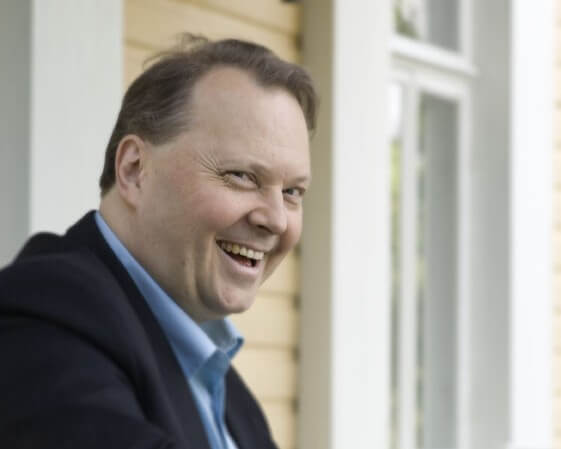
Seven questions for Timo-Juhani Kyllönen
1. You have composed music for a variety of ensembles. In recent years, vocal music has come to occupy a central role in your work. What inspires you?
Through words and music, it is possible to express profound emotions and reflect deep-rooted soulscapes. I enjoy singing, and because I love languages and speak eight languages, vocal music has become a natural part of my work. When I examine texts, I always look for the poetic melodic lines and intonation that exist in different ways in different languages. Language and music share the same strong emotional charge, and music strengthens this symbiosis. This creates the expressive melodic and vocal power in my compositions.
2. You have composed two monologue operas: Tango Solo and Ilona irti (Release the Joy). They are set in very different environments, but both share a strong soprano role and a powerful message. How did these works come about?
The libretto for Tango Solo is by Maritza Núñez and is written in Spanish. On the streets of Buenos Aires, she had encountered a poor old woman and her dog. There she came up with this “story to tell”. The tragic themes reflect the horrors of the Argentine dictatorship of the 1980s, and they remain highly relevant today. When I composed the opera in 2010–2011, I used rhythmic elements from milonga and Argentine tango, among others, to create an authentic atmosphere. I had already composed a tango when I was 11; it was published, and I performed Argentine tangos on the accordion. These childhood experiences inspired me subconsciously when I was commissioned to write the opera.
Ilona irti was commissioned by the Organ Night and Aria festival, and Leena Lehtolainen was invited to write the libretto. It deals with the position and problems of women in modern society and tackles the MeToo movement from different perspectives. The opera was inspired by my daughter, soprano Aurora Marthens, who won the Timo Mustakallio Singing Competition in 2017. In the same year, the MeToo movement became a global phenomenon.
3. Your 70th birthday will be celebrated with a focus concert at Sellosali in Espoo on 22 November [2025]. The programme includes a wide selection of your works. Which ones would you like to highlight?
The concert combines Finnish, English and Norwegian poetry with modern instrumental and vocal music. The Tapiola Chamber Choir, conducted by Hannu Norjanen, will premiere the Eino Leino Cycle — a work I had long been planning — and Three Egyptian Songs, whose texts are taken from the ancient Egyptian Book of the Dead. Songs from the popular Norppaooppera (The Seal), commissioned by the Savonlinna Opera Festival, will also be heard. The Sonata for Violin and Piano, Op. 103 will receive its world premiere. The concert will close with the Edvard Munch Suite; the texts were written by Munch himself on the backs of his paintings. It was a strange coincidence that on the day of the Oslo premiere, the stolen paintings in question were found.
4. You have composed an opera about Ernest Hemingway. How did it originate, and how did you come to choose that subject?
The work originated from the theatre play by Maritza Núñez on which the opera’s Spanish libretto is based. It is a fascinating story about the life and final moments of Ernest Hemingway. His great artistic personality and his life have always fascinated me. When I read the play, I immediately noticed that it traced an exciting dramatic arc and a psychologically compelling gallery of characters. For example, Marlene Dietrich sings and dances with Hemingway in a cabaret-style scene. Performances of the opera are planned for next year in Finland and elsewhere.
5. Your output also includes orchestral music, such as the Accordion Concerto (2000) and the Trumpet Concerto Cadiz (2012). You are now planning a new symphony. What is it like to compose orchestral music when several of your recent works have focused on text and vocal soloists?
I am indeed working on my three-movement Symphony No. 2. Creating it has been fascinating, and it had been waiting in draft form for many years. When I received a state artist’s pension, I was finally able to focus on this work as well. In my youth, I studied at the Tchaikovsky Conservatory, and my orchestration teacher was Yuri Fortunatov, who had been Prokofiev’s favourite student. From him, I received a solid education. In 1986, the Novosibirsk Symphony Orchestra premiered my first symphony live on TV. I will never forget the overwhelming feeling of happiness when I heard it played by that large orchestra!
My love of vocal music is also reflected in the new symphony; the second movement features a soprano vocalise. The work is also a statement. Climate change, the suffering of nature and animals, and the extinction of species are all caused by human greed, arrogance and indifference. However, I believe that everything good and true holds the world together, and that a higher spiritual essence within us will fight evil.
6. Throughout your career, you have also composed chamber and instrumental music. A recent work is Trio No. 5 for violin, flute and piano, which Ensemble Cameo premiered in Tokyo last year. How did this collaboration begin — and what other works would you like to highlight?
The Japanese pianist Kyoko Fukushi contacted me last spring and told me about the trio’s upcoming performance in Japan. They had discovered the work published by Fennica Gehrman and were excited about it. I was invited to the Tokyo premiere, and I plan to continue working with the ensemble in the coming years.
My second string quartet, commissioned by the Kuhmo Chamber Music Festival, is another major work. I have arranged both my quartets for string orchestra and conducted them in Sweden when I was spotlight composer of the Bergslagen Chamber Orchestra in 2015. I would also highlight my symphonic poem Lichtenthal. Its German premiere by the Jenaer Philharmonie in 2010 came about when the French conductor Fabrice Bollon heard a recording of the work. Ciclo para coro mixto was performed and recorded by the winner of the Kanagawa International Choir Festival in 1990. The Mississippi Choir later won a choral competition in Italy with the same piece. It is a pleasure to see that people around the world are interested in my works.
7. What is the source of your inexhaustible energy and positivity?
I feel that as a composer and musician, I am a mediator. I am happiest when I get to create something that can touch my fellow human beings and transmit positive energy. I believe in compassion and kindness. Love, faith and hope give strength, and as the Bible says, love is the greatest of all. I am deeply grateful to my family, who have always supported me in my creative work.
Read more about Timo-Juhani Kyllönen and his works.
Henna Salmela
Photo: Saara Vuorjoki