

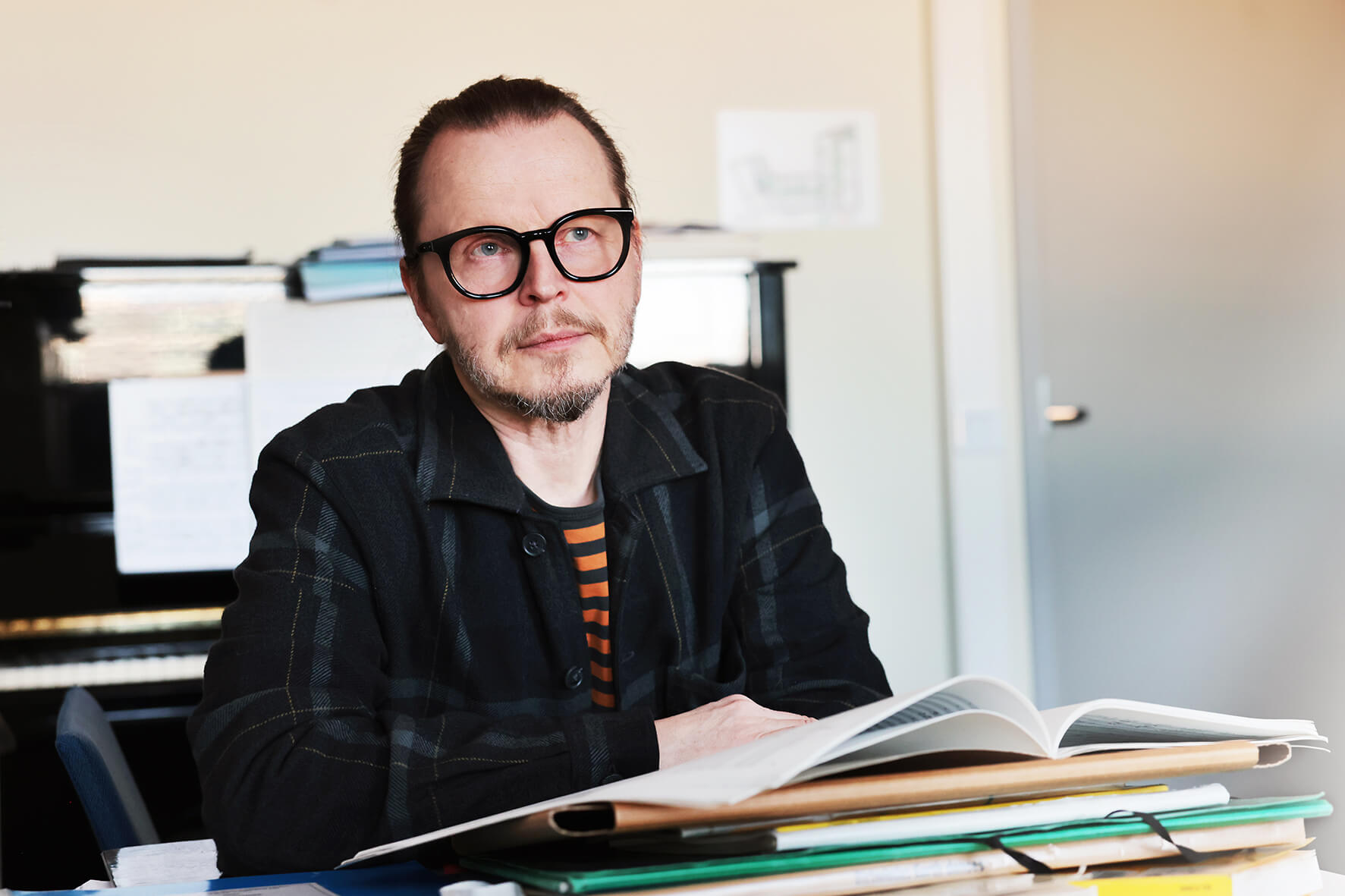
Seven questions for Veli-Matti Puumala
Veli-Matti Puumala, who will be 60 on 18 July [2025], here answers questions about his composing process, work as a teacher of the new composer generation and the guiding stars in his life.
1. How do you set about composing a new work — and are there any “standard methods” in your composition process?
The first decisions are always influenced by how long the work is going to be, what the ensemble is and also for whom I am writing. If it is an extensive work, I always draft a plan for the form and the timeline: what happens when. At the same time, I am well aware that this plan will most likely change once I come to grips with the actual material. But I cannot get started without this roadmap. For some of my works, I have drawn up a very precise template for rhythm and metre before I even began to sketch out other elements. For some others, their shape was governed by a harmony outline.
For a minor work, I may start with a textural detail and see where it takes me in relation to the big picture. The overall shape of the work will then come into being as the piece emerges. If I am writing for an orchestra or other large ensemble, I generally draw up a preliminary plan of how to use the ensemble and how to assign roles to the various instrument groups as the piece progresses.
The actual composition process does not properly get under way until I discover musical material that is suitably engaging for all the senses. One has to be patient and allow time to listen to material that has not yet attached itself to a time and a place. Harmony is important for me. It is difficult to imagine writing music without it. I can spend any amount of time searching for harmony and related sounds, but at some point I have to start actually composing the music. It is not until one begins to find a context for details that one begins to understand what the significance, scope and role of those details could be in the finished work. This is among the most enjoyable phases of the composition process: when one begins to understand what kind of a work might be emerging from the material at hand.
2. You’ve had a long career as Professor of Composition at the Sibelius Academy. What is your approach in teaching composition?
Teaching is always interaction, with impulses going both ways. My priority is always to meet the person, to learn about their personality and how they think. The substantive stuff comes after that. Over weeks and months, my conception of a student’s personality, musical worldview and strengths becomes more accurate and sometimes changes quite significantly. Initially, I may have an idea about which skills the student needs to acquire, but these needs are highly individual and inextricably linked to the musical expression towards which the student is striving. As a teacher, my job is to sense this direction. On the one hand, I encourage the student to reinforce their individual idiom. On the other hand, it is equally important to ensure that the student does not get in the way of their own development, by helping them to see directions where they could already have potential to go.
Teaching involves a lot of verbalising. Generally, the best kind of interaction is where contact is intense and we are excited by the same things, and the student seems to have a significant insight about what they are doing. This is very rewarding for me; I learn about music and about the student. However, an immediate insight is not essential. Sometimes the ‘lightbulb moment’ can come weeks or months later.
3. Which of your works have a particular meaning for you?
There have been important works or performances in every decade.
1980s: The performance of my early work Symbo at the UNM festival in 1986. It was my first performance abroad, and it was juxtaposed with works by Nordic colleagues at a similar stage of development as myself.
1990s: My first composition concert at the Helsinki Biennale in 1993 and the world premiere of Tutta Via for chamber orchestra. But more particularly I would name my First String Quartet and its half-premiere by the Danske Kvartet in Denmark and full premiere by the New Helsinki Quartet at Kuhmo one week later. Both of these works — particularly the Quartet — were performed multiple times at home and abroad. The Quartet shaped for me what I am like as a composer. It also opened doors.
2000s: The piano concerto Seeds of Time, commissioned by Susanna Mälkki and Hannu Lintu. Both conducted the piece abroad, even in Paris. This was a work where I managed again to expand and deepen my musical idiom. However, perhaps the most emotionally significant phase in my composing career was the opera Anna Liisa, premiered at the Helsinki Festival in 2008. The rehearsals and performances in particular drove home to me how meaningful it is to have a large group of people doing their best and exceeding themselves in pursuit of a common goal. I realised how hugely I enjoyed interacting with other people.
2010s: The orchestral works Rope and Tear were significant, because in them I updated my orchestral sound.
2020s: To date, my most significant work of the 2020s is the violin concerto Tree of Memories, written for Carolin Widmann. It was wonderful to collaborate with such a diverse talent and great human being as she is. This is the third concerto proper that I have written. I like the concerto format. It provides many opportunities for building orchestral textures and dramaturgical situations.
4. What would you like to focus on in the future: vocal music, opera, concertos or others — and what are your next plans?
There are solo works and a chamber opera in my near future, along with some orchestral music. I am writing a solo accordion work for Janne Valkeajoki and expanding my set of piano etudes. The chamber opera is a project with Johanna Venho. My Second String Quartet, premiered the year before last by the Kamus Quartet, led me to think about further quartets. I already have sketches for a third and a fourth one. I would also like to revisit the ensemble format, if such a project were to come along, and explore electroacoustic music.
5. What would be your advice to a young Puumala today?
As a young composer, we each search for our own voice and our place in the world. It is important to feel free to do whatever feels important and to write music that one can own. But it is not enough. Music is made for sharing with other people. Because we composers exist in close interaction with musicians, I would encourage my younger self to pay close attention to which things musicians find difficult in my music and to think long and hard about what conclusions I should draw from that. Is the image I am shaping of myself correct? Is it consistent with my experiences? Where is the line between, on the one hand, integrity and precision of self-expression and, on the other hand, the notion of music as communication, where a score is simply a starting point for interpretation?
I would also tell my younger self to spend time abroad, whether studying or otherwise.
6. Could you tell us something about you that we don’t yet know — your interests or other important pastimes?
It is very important for me to put on my cap and overalls and get my hands dirty. This means things like sawing, splitting and piling logs at the summer cottage or doing some other DIY work. I also love tending flowers and growing saplings. I enjoy long walks, runs and bike rides that quicken the pulse and provide necessary rest for the brain by creating a private space. Yoga does the same.
7. What are the guiding stars in your life?
I recently became a father again and am more convinced than ever that we are here for other people. Family and loved ones are the most important things. And human relationships more broadly. This includes the relationships formed with students and colleagues in teaching. This is an important priority to understand in an occupation that requires a lot of alone time and personal space for artistic creative work to be possible. Time set aside for writing music has no meaning without all of the above.
Read more about Veli-Matti Puumala and his works
Henna Salmela
Photo: Maarit Kytöharju