

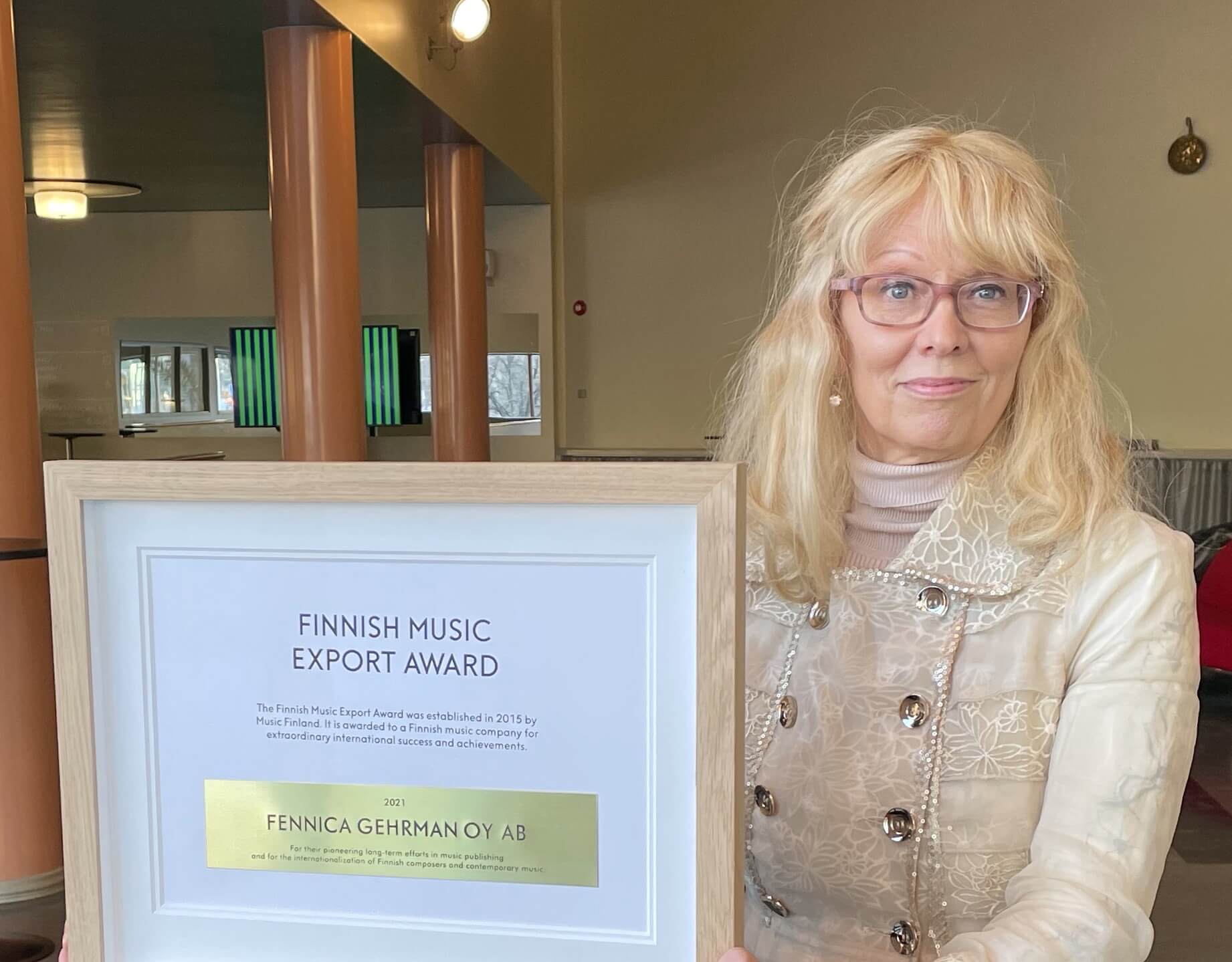
7 questions for Henna Salmela
Director of Administration Henna Salmela is retiring after an extensive and distinguished career of 36 years in music publishing. She joined Fazer Musiikki as a press officer and has witnessed the company’s evolution from a small part in a major corporation into an independent and active operator in the field of art music. Here, she looks back and shares some of her innumerable encounters, incidents and memorable moments.
What has been the best thing in your career?
Working with music is a privilege. Memorable concerts, meeting composers and having interesting discussions with them about just about anything between heaven and earth. Being able to contribute to the emerging of new works and to help with the process that begins on the composer’s desk and culminates in the concert hall. A publishing house cannot be a freezer or a microwave but more like an old-fashioned baking oven, keeping the music continuously warm and alive. Fennica Gehrman has an extensive historical catalogue that features both the finest legacy content and the cutting edge of Finnish art music. The Music Export Prize by Music Finland that we were awarded in 2021 was an important acknowledgement of the work we do.
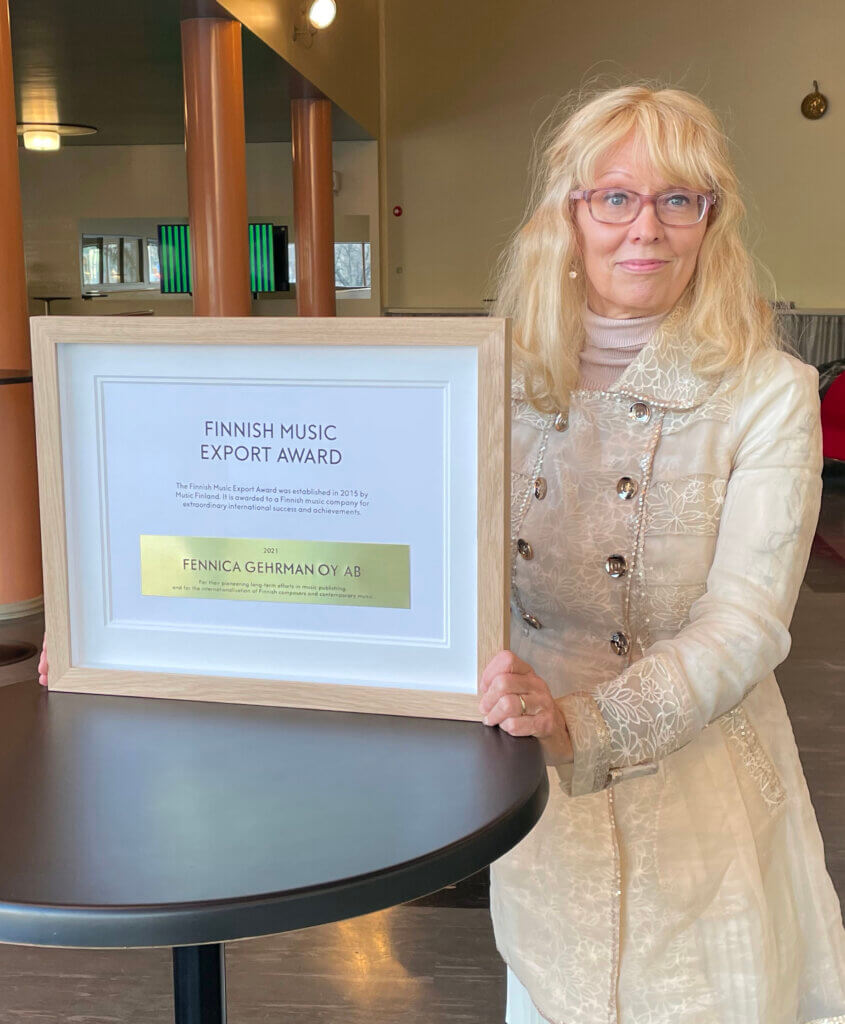
We work to promote good things. We minimise our environmental load, we advocate for culture and we contribute to enriching our musical legacy. When we celebrated the 20th anniversary of Fennica Gehrman, I suggested commissioning violin works from several composers and then printing them, and they were also performed. This was a concrete measure to foster new music.
You are particularly fond of piano music. How has this manifested in your work?
The archives of any music publisher contain treasures for which there is no longer any demand as individual pieces. I have edited collections of piano pieces, featuring repertoire that I, as a pianist trained at the Sibelius Academy, wanted to rescue from oblivion and enable people to play them from proper sheet music rather than nth-generation photocopies. In a small publishing house, you can and should bring forward your own ideas! My background in business and economics helped in evaluating which items might be in demand.
Finnish operas have enjoyed success internationally, and you have also been involved in the process of commissioning several major orchestral works. Can you point to any particularly memorable moments?
At the turn of the millennium, opera houses in northern Germany (e.g. in Lübeck and Hagen) were very active in sourcing Nordic operas, and they were in frequent contact with us. Operas by Rautavaara were staged in Hagen, Kiel and Greifswald. In Lübeck, they staged Kalevi Aho’s Before We All Have Drowned, and finally Rautavaara’s Rasputin in 2006. All of these productions were in German; the libretto translations were commissioned by us. It was a pleasure to contribute to and see these productions.
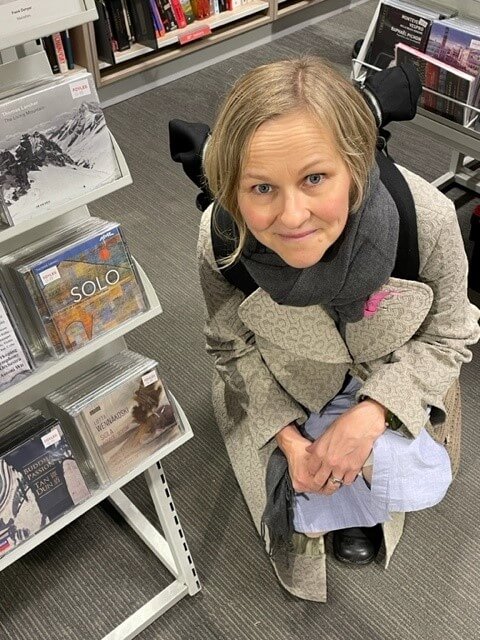
Lotta Wennäkoski has been in particular demand in recent years, receiving international joint commissions such as Flounce, premiered at the BBC Proms, and the violin concerto Prosoidia, both commissioned by the BBC. Their genesis was boosted by personal visits to BBC offices in Maida Vale. I most recently witnessed a sign of Lotta’s success in Amsterdam in autumn 2025 at the time of the premiere of her recorder concerto Vents et lyres, when we found that she had a named divider of her own in the CD rack at a local record shop. She also appeared on recordings found in London.
Einojuhani Rautavaara experienced an upswing to his career in the 1990s when his symphony Angel of Light made an international breakthrough. How was the publisher involved in this?
It was exciting to watch how the concert halls and music media of the world embraced Rautavaara — on the wings of an angel, as it were. When we celebrate his centenary in 2028, it will be fascinating to look back at the time when he evolved into an international major name.
As publishers, we did our bit in promoting Rautavaara. We collaborated with Finnish embassies to lobby radio stations around the world to play Rautavaara’s music. We distributed the book and CD Rautavaara Orchestral Works to media and people in the music industry. Over the years, Cantus arcticus became a major hit, being at one point performed somewhere in the world every week. The Ondine record label and Finnish Music Information Centre’s executive director Pekka Hako were vitally important in fostering the success of Angel of Light.
Rautavaara himself was an imposing figure, with a penetrating gaze and an eccentric style of speech. “In the world of beauty I can be an absolute monarch,” was one of his enduring aphorisms.
Which premieres of Kalevi Aho do you especially remember?
Kalevi Aho’s concerto project took flight with the Flute Concerto, or more properly with the Clarinet Concerto. Martin Fröst was awarded funding by the Borletti-Buitoni Foundation to commission a concerto from Aho. The Foundation later supported several other soloists similarly, and as Aho acquired a reputation as a competent and dependable concerto composer, the requests began to flood in.
One of the most curious was the Contrabassoon Concerto commissioned by US bassoonist Lewis Lipnik. He was a member of the Washington National Symphony and a colourful personality, sometimes appearing as ‘the Contrabass Elf’ in a green outfit.
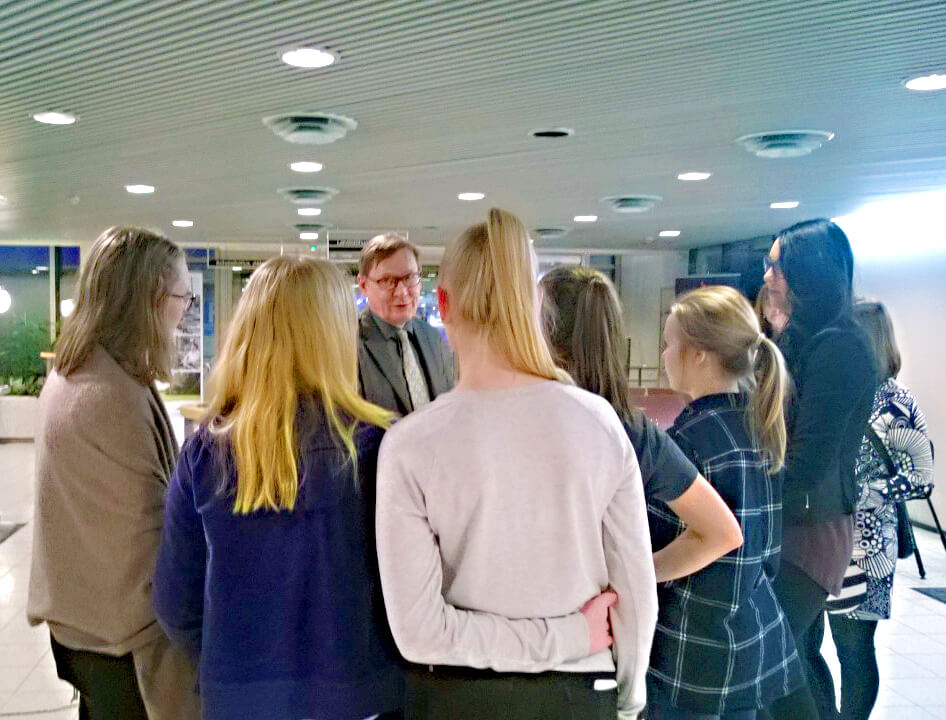
Several other Aho concerts were given multiple performances in Finland and abroad. The DeFilharmonie orchestra in Antwerp developed an enthusiasm for Aho, resulting in the composer being able to sample his favourite Belgian beers on site. One of the most memorable occasions in Finland was the premiere of the Tenor Saxophone Concerto in Lappeenranta, where schoolgirls mobbed Kalevi Aho like a pop star in the interval.
At the time of the premiere of Aho’s Luosto Symphony, the General Manager of the Lapland Chamber Orchestra and myself went picking blueberries on the spur of the moment. She was an avid berry picker and had pails and boots in the back of her car.
Trade fairs enabled Fennica Gehrman to licence the Colourstrings violin method of Géza Szilvay to the Chinese market. How did that happen?
The Frankfurt Music Fair was for decades the place to be for music publishers to present sheet music, follow trends in the industry and meet colleagues from abroad.

The fair expanded to Shanghai, and we went there in hopes of finding partners and establishing licensing agreements with local operators. After several years, Publishing Manager Ari Nieminen and myself succeeded in signing an agreement with a publisher in Beijing to introduce the Colourstrings violin method on the Chinese market. We also collaborated with a publisher in Shanghai on publications of Sibelius’s music. Exhibition stands arranged by Music Finland provided us with a broader foundation for these efforts.
You must have a considerable trove of anecdotes from your years on the job. Would you share some of them?
In 1993, Fazer Musiikki sold its publishing catalogue to the Warner Music Group, heralding the dismantling of a major player on the Finnish music scene. Big bosses from the USA came to inspect their acquisition, arriving in a white limo. Unfortunately, the limo got stuck on the tight curves of the entryway to the underground car park, forcing the visitors to struggle out of the vehicle, climb up onto the loading dock and make a memorable entrance via the goods lift!
We continued to work for music under new ownership, but in 2002 the newly founded Fennica Gehrman managed to reclaim the art music catalogue and return it to Finnish ownership — thanks largely to the efforts of John Eric Westö. We were standing on our own feet again.
I have often thanked my intuition for catching typos. Sometimes a commissioning agreement might read “Could you please sing the agreement”, and I’ve sometimes hurriedly began an e-mail by typing “Thank you for your lovely massage”. Fortunately, in the publishing business one is used to proofreading absolutely everything. Once we nearly had an extra marking copied into a score because an insect had landed on the glass of the photocopier, but this too was caught in time.
Translation: Jaakko Mäntyjärvi
Published in Highlights 2/2026